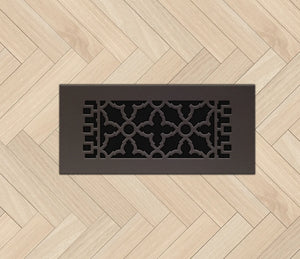

A Designer’s Pick: Sunray Grilles in a 1907 Showcase House
A Q&A with Rhonda Angell, Rhonda Angell Interior Design
We talked to interior designer Rhonda Angell, who designed Le Petit en Suite, a bathroom in the 2026 Pasadena Showcase House of Design. Her design married William Morris wallpaper, aged brass, and marble elements. When she needed a wall vent design fit for the 1907 shingle-style home, she specified the Sunray Metal Grille in white with beveled edges. Below, she explains how that choice was made, and why she no longer treats registers as an afterthought.
The Pasadena Showcase House of Design is presented by Pasadena Showcase House for the Arts, a California-based nonprofit founded in 1948 whose proceeds support music programming and education.
Before and After

Before: dark green striped wallpaper, an octagonal tile floor with green accents, and a tiled vanity run.

After: the same footprint, reworked around marble tile, brass accents, and a Morris paper.
Meet the Designer
Rhonda AngellFounder & Principal Designer, Rhonda Angell Interior Design 
Rhonda Angell is the founder and principal designer of Rhonda Angell Interior Design, a Southern California–based firm known for creating thoughtful, highly personal interiors. With a background spanning advertising, film production, and construction, Rhonda brings both a creative eye and a practical understanding of how beautifully designed spaces come together. As a LEED Green Associate with a passion for sustainable design, she approaches each project with an eye for thoughtful choices, lasting impact, and the details that make a space feel distinctly its own. |
The Project
| Project | Le Petit en Suite, 2026 Pasadena Showcase House of Design |
|---|---|
| Designer | Rhonda Angell, Rhonda Angell Interior Design |
| Location | Pasadena, California; built 1907 |
| Product | Sunray Metal Grille |
| Pattern | Sunray |
| Finish | White |
| Edge | Beveled (45° on all four sides of the top frame) |
| Installation | Wall |
| Material | Aluminum |
| Size | Custom |

The Sunray grille in white, set into the upper wall above the picture rail. The screws match the finish.
Q&A with Rhonda Angell
Content has been lightly edited for clarity.
For the Pasadena Showcase House, why did you choose the Sunray design in white for the bathroom? How did that tie in with the space you were designing?
Oh my gosh - the Sunray design could not have been more perfect! In my bathroom, Le Petit en Suite, I used a William Morris wallpaper, and Sunray in white with beveled edges was the perfect complement. It worked beautifully, not only with the wallpaper, but with the entire home, which was originally built in 1907. Every detail in the room was chosen to honor the home’s architecture while updating it for the way we live today. Sunray embodied that philosophy beautifully. And to be honest, I was amazed by how many visitors noticed the register and stopped to ask about it. And can we talk about the matching screws? It’s such a small detail, but it’s exactly the kind of thoughtful finishing touch that makes all the difference. I love partnering with companies that value those little details just as much as I do.
“I was amazed by how many visitors noticed the register and stopped to ask about it.”
Rhonda Angell
EDITOR’S NOTE — From the team at Reggio Register.
For a grille that blends seamlessly into a historic home, look for period-appropriate patterns and architectural details. Here, the Sunray’s repeating pattern works beautifully with early-20th century millwork. Beveled edges add a 45° angle on all four sides of the top frame, softening the transition.
When you’re designing a space, what separates a truly finished room from one that still feels incomplete?
In general, there are so many touchpoints to consider in completing a room - from the things one may not think about, like the paint finish (i.e., flat or semi-gloss, etc.) to - and this is a big one for me - how the newly designed room fits with the adjacent rooms and the rest of the house. If I’m working with a client on one space, I try to assess if they have plans to work on other areas of the house in the future, or just this one room. That answer can greatly impact how I approach the design in the space, as you don’t want one room to stand out like it doesn’t belong with the rest of house. Flow is so important in making a space feel complete and cohesive within a home.
HVAC registers are often treated as an afterthought. Why do you think they’re an important design element, and how do you approach selecting them for your projects?
Even before becoming an interior designer, I have always been obsessed with even the tiniest details. I tend to notice the little things that many people overlook, and those are often the elements that make the biggest impact. I really don’t think registers should be looked at as an afterthought. Not only are they typically quite prominent in a room, but there are usually many of them. Incorporating beautiful register and return covers into the design concept only enhances the final space. To be honest, since I’ve started using Reggio Registers in my projects, standard builder-grade register covers are one of those details I can’t help but notice. It’s amazing what a difference such a seemingly small element can make in the overall feel of the room.
“Since I’ve started using Reggio Registers in my projects, standard builder-grade register covers are one of those details I can’t help but notice.”
Rhonda Angell
You’ve worked with Reggio Registers. How did they compare to other register and grille options you’ve specified in terms of design and quality?
For me, in addition to the design and quality of a product, customer service is something that weighs heavily in my decision to work with a brand. As a designer, I am responsible for the outcome of the design and for products that I am recommending to my clients, so I have to be very confident and knowledgeable with my selections. When I was working on my first order, I reached out by phone to the customer service department, and the rep who helped me was so patient, answering all my (many) questions, and making me feel so comfortable with the customization options. He helped educate me on how to properly measure the vent opening so I could correctly specify the size and he also assisted in directing me to the best material option for my specific project. And the designs - so many stunning and unique choices, whether you are working on a modern or a classic space.
EDITOR’S NOTE — From the team at Reggio Register.
For a bathroom wall, aluminum is the rust-proof choice. Need help deciding on the right material for your own project? Check out our materials guide.
What stood out most about Reggio’s products?
The overall experience was really special. I am definitely a questions-girl, and it took more than one call to finalize my order. The rep always made me feel welcome to reach out and ask questions, clarify details and he made sure I was completely clear on the process.
What advice would you give to homeowners or fellow designers who are choosing registers and grilles for a renovation or new build?
Do it!! When you’re already making an investment in your space, beautiful registers deserve a place in the budget. It’s often the smallest, most thoughtful details that leave the biggest impression and transform a room from beautiful to unforgettable.
More from the Room

Black marble vanity top with aged brass wall-mount faucet.

Aged brass shower valve against marble mosaic tile.

Brass-topped bottles in the marble shower niche.

The Sunray grille in context.
Get the Look
Every room in a showcase house is special, which means every detail of a design matters — even the vents. But the same can be true for any home or project. Ready to get started? We’re here to help.
For Pros: Designers and trade professionals can register for trade pricing and dedicated support.
Sign up for exclusive offers and be the first to know about new developments at Reggio Register.